
Hauser + Wirth Welcome Ambera Wellmann to Artist Roster
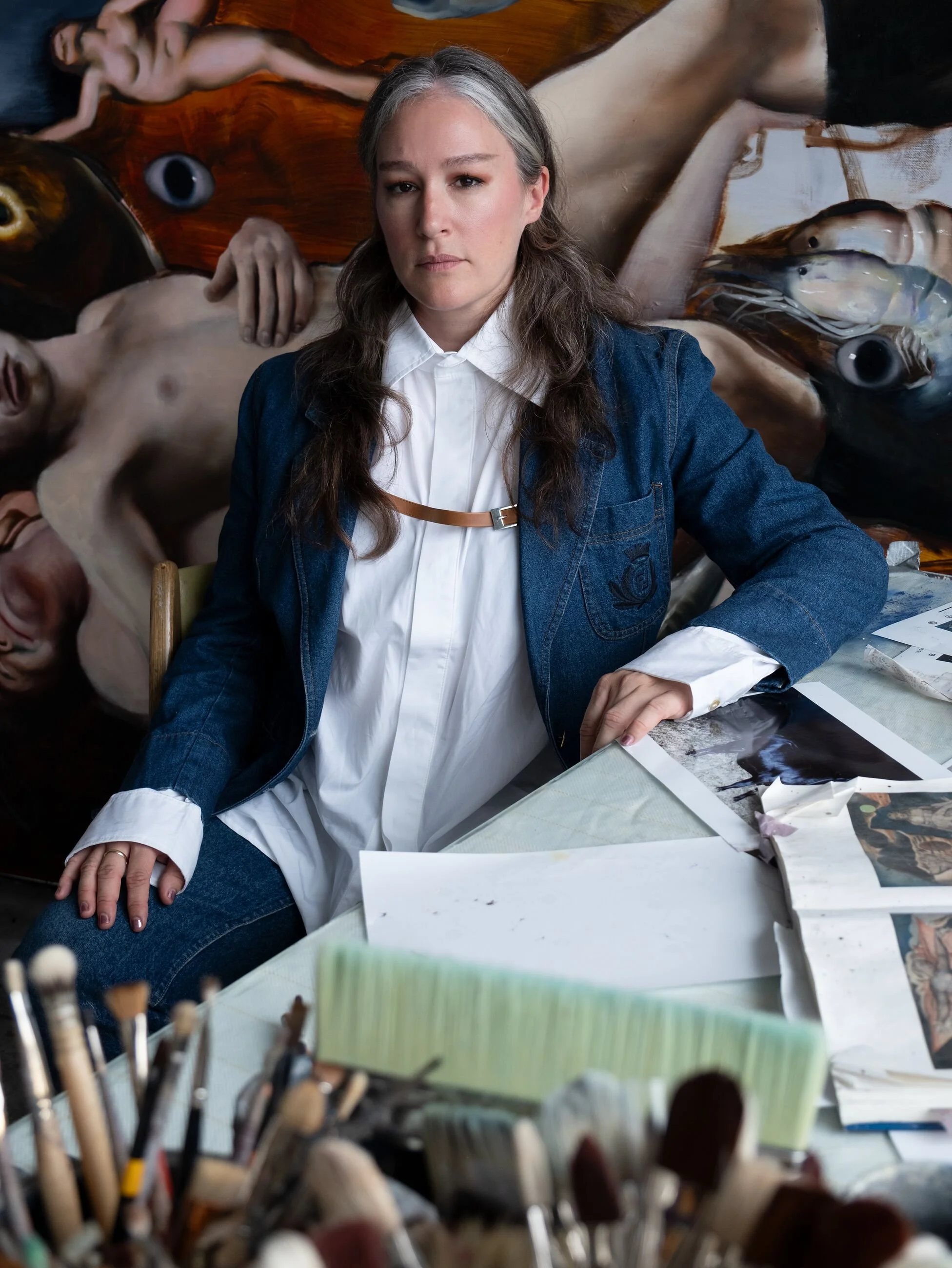
Photo: Christian DeFonte
From the Hauser & Wirth: We are pleased to announce representation of Nova Scotia-born, New York-based artist Ambera Wellmann, in joint partnership with Company Gallery, NY. Wellmann has attracted international critical approbation for paintings that depict worlds within worlds, populated by human and animal forms emerging from and dissolving into each other and the atmosphere.
Rendered in oils with a technical dexterity that recalls the work of Renaissance and Baroque masters, her canvases are filled with unanchored figures and disembodied faces, shimmering swaths of illumination and darkness, anachronistic details and indeterminate spaces that circle and move in defiance of hierarchy, pointing instead to metamorphosis, vulnerability and collectivity as subjects. In their refusal of familiar typologies and binaries, Wellmann’s apparitions exist in a space where multiple contradictory experiences happen at once—the violent and the tender, carnal and spiritual, abject and transcendent, and the simply inexplicable—at the threshold of a future in which viewers are compelled to imagine themselves as participants.
In January 2024, Hauser & Wirth will present new work by Wellmann as a highlight of its stand at the tenth annual edition of FOG Design + Art in San Francisco (18 – 21 January). The gallery’s first major solo exhibition with the artist will open to the public in Fall 2024 at Hauser & Wirth’s Soho space on Wooster Street in New York City, complemented by a simultaneous solo exhibition at Company’s nearby location on Elizabeth Street. In September 2024, Wellmann also will be a featured artist of the 15th Gwangju Biennale exhibition ‘PANSORI—a soundscape of the 21st century,’ curated by Nicolas Bourriaud.
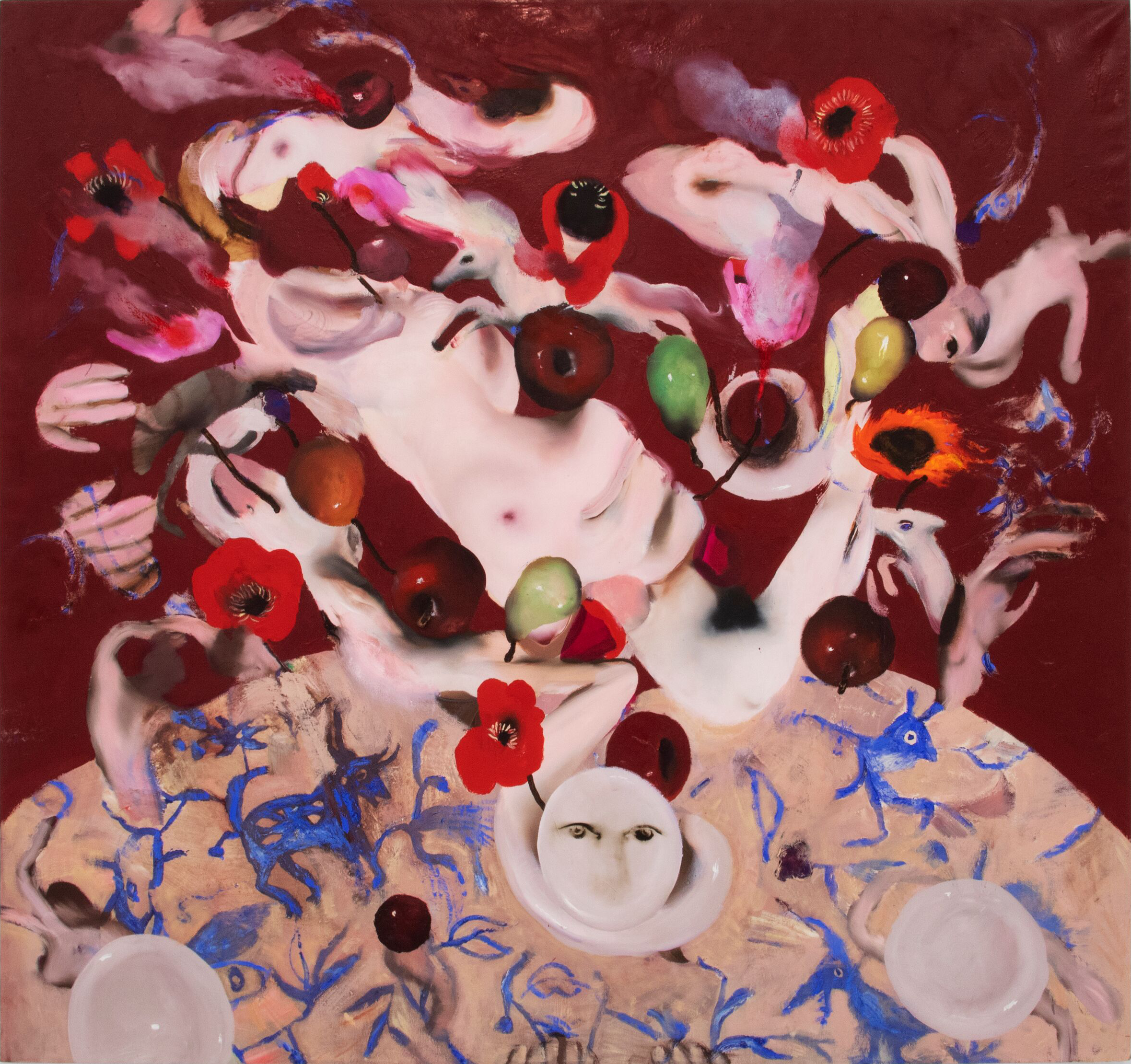
Ambera Wellmann, Séance Etiquette, 2020 © Ambera Wellmann. Courtesy the artist, Hauser & Wirth and Company Gallery
About the artist: “In 2017, Wellmann won the prestigious RBC Canadian Painting Competition for work that explored many of the themes and methods she continues to pursue today in paintings constructed from numerous layers of intricately worked wet oils, often depicting nebulous human and animal forms, sometimes in extremis or entwined in states of ecstasy, figurative in only a tenuous sense. ‘I am often just looking for an arrangement with the bodies that actually feels impossible,’ Wellmann says, ‘in order to create a diagram for what kind of infinite possibilities the body can have.’
Wellmann’s work accrues through what she has described as a visual version of catachresis, the process in which a word is deliberately deployed incorrectly; her ‘painterly catachresis’ manifests through irrational pictorial space and the depiction of an indeterminate number of bodies, genders, species, all without any predetermined visual hierarchy. Wellmann’s art thus occurs at the frontier where the known meets the uncanny, ‘the moment in which things become impossible, either figuratively or spatially, but which still register in a way that makes formal sense,’ she explains. ‘This uncertainty is a form of intimacy (something unrecognizable is, oddly, the place in which we can recognize ourselves the most).’”